
What Are You Looking For?
At the exact moment a transformer is energized, an unsettling scenario often unfolds.
No external fault. No insulation failure. Yet the high-voltage fuse operates instantly and unnecessarily.
This is not a short circuit.
It is magnetizing inrush current asserting itself.
Selecting a fuse that can protect against genuine faults while enduring the brutal first milliseconds of energization is a nuanced engineering exercise. IEEE C37.48.1 provides the technical compass.
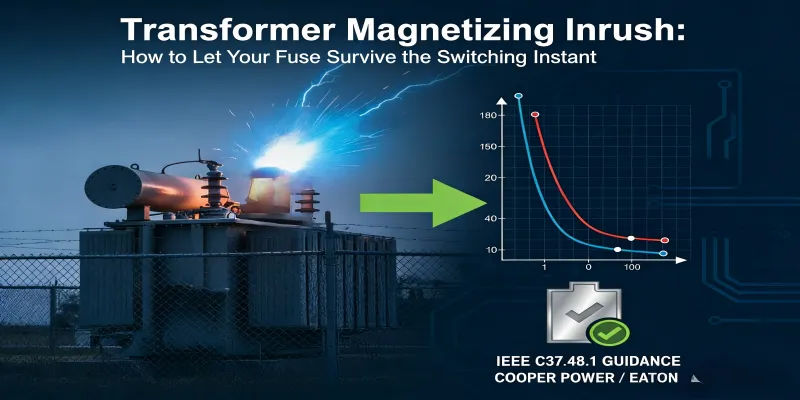
When a transformer is first energized, the magnetic flux within its core cannot change instantaneously. To establish the required magnetic field, the primary winding momentarily draws an abnormally large current.
Magnitude
Inrush current commonly reaches 8 to 12 times rated current, and in unfavorable switching conditions, even higher.
Duration
The event is fleeting—typically around 0.1 seconds—but the thermal energy released during this short interval is more than sufficient to fatigue or melt an undersized fuse element.
This transient is benign to the transformer.
It is lethal to poorly coordinated protection.
(Based on IEEE C37.48.1, Clause 6.1.3.1)
IEEE guidance is explicit:
To prevent nuisance operation, the fuse’s minimum melting time–current characteristic (TCC) must lie above the transformer inrush envelope.
Two industry-recognized reference points define this envelope:
12 × rated current for 0.1 seconds
The standard verification point for most distribution transformers.
25 × rated current for 0.01 seconds
Used to assess extreme energization conditions at the very first electrical instant.
If the fuse’s minimum melt curve intersects either point, misoperation is not a possibility—it is a certainty.
Protection coordination is not guesswork.
It is geometry on logarithmic paper.
Engineers must explicitly plot the transformer inrush points onto the fuse TCC chart and apply a disciplined margin strategy:
Mandatory Clearance
A minimum 20% current margin should exist between the inrush point and the fuse’s minimum melting curve.
Thermal Cycling Reality
Clause 6.1.1 warns of an insidious failure mode. Repeated energization causes cyclic heating and cooling of the fuse element. When each inrush drives the element close to its melting threshold, the metal undergoes cumulative fatigue. Eventually, the fuse opens under perfectly normal load—mysterious, inconvenient, and entirely predictable in hindsight.
Consider a 167 kVA / 19.92 kV transformer.
Rated primary current: ~8.38 A
12× inrush reference: ~100 A at 0.1 seconds
Selection Insight
A 25 A Dual-Sensing Bay-O-Net fuse—such as those offered in Eaton Cooper designs—has a minimum melting current well above 100 A at 0.1 seconds.
The result is elegant coordination:
No operation during energization
Reliable response to sustained overloads
Proper discrimination with downstream protection
The fuse survives the inrush.
The system survives the fault.
(Clause 6.1.4)
When protecting an entire feeder rather than a single unit, a new adversary emerges: cold load pickup.
After extended outages, simultaneous magnetizing inrush, motor restarting currents, and re-energized lighting loads stack together. The aggregate effect can dwarf single-unit calculations.
Upstream fuses must therefore tolerate not just one inrush event—but many, occurring at once.
A fuse exists not merely to open a circuit, but to remain intact when opening is unnecessary.
Understanding the physics of magnetizing inrush and rigorously validating fuse TCC curves against IEEE C37.48.1 criteria transforms protection from trial-and-error into engineering certainty. When done correctly, the transformer energizes cleanly, the fuse holds firm, and the system moves seamlessly from theory into service.