
What Are You Looking For?
Across urban and suburban electrical grids worldwide, underground distribution has become the preferred method for delivering power to neighborhoods, commercial districts, and industrial facilities. But while underground cables get most of the attention, it is the pad-mounted transformers and switchgear at grade level that make the entire system work.
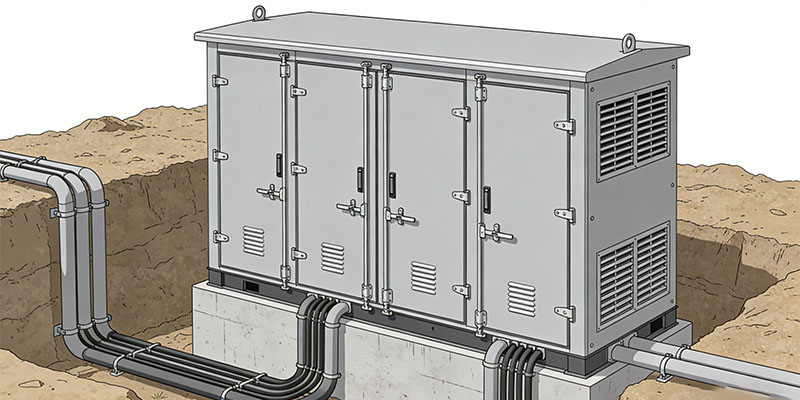
Pad-mounted switchgear refers to ground-level electrical distribution equipment housed in a tamper-resistant enclosure, typically rated for NEMA 3R or higher outdoor service. These units house switches, fuses, and protective devices that control the flow of electricity through underground feeders.
They are called “pad-mounted” because they are installed on a concrete pad at ground level — making them accessible for maintenance while keeping energized components away from public contact.
Inside every pad-mounted transformer and switchgear lineup, separable insulated connectors — including elbow connectors, bushing inserts, and feedthrough accessories — provide the critical interfaces between the transformer bushings and the underground cable system.
These connectors must withstand:
A typical underground distribution system serving a commercial complex or residential subdivision will include:
Unlike overhead lines where a fault may only affect one customer, an underground fault can be difficult to locate and may require excavation to repair. This makes the reliability of every connector and protective device in the underground system critically important.
Using IEEE/ANSI compliant components from established manufacturers — whether Eaton Cooper original products or certified alternatives like those supplied by Jiuyingtech — is the foundation of a reliable underground distribution network.