
Bay-O-Net Fuse Selection: Types, Coordination, and Application
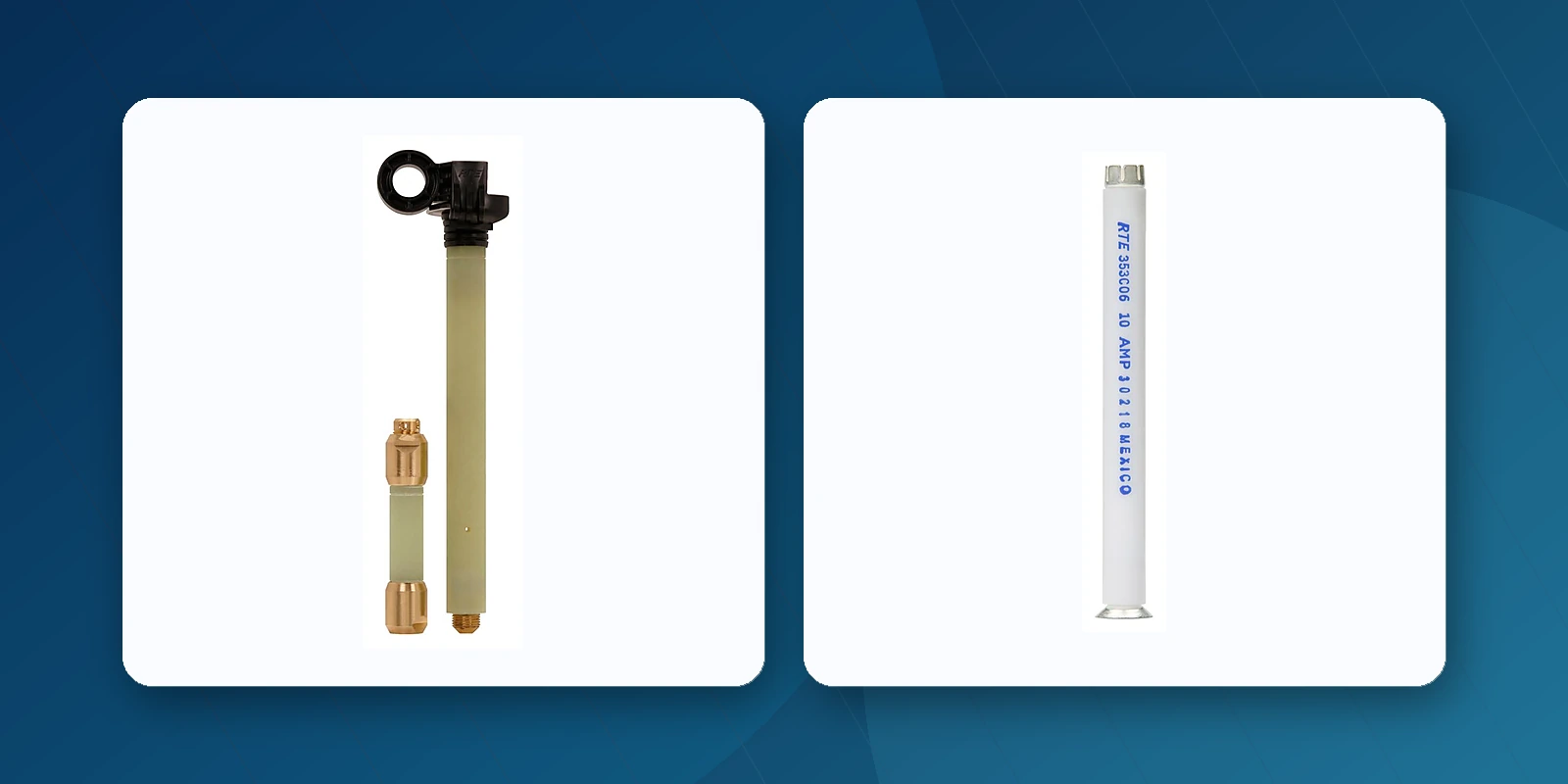
1. What Makes Bay-O-Net Fuses Different?
Traditional transformer fuses — whether internal cartridge types or external cutouts — each have significant limitations. Cartridge fuses require the transformer tank to be opened for replacement, introducing the risk of oil contamination and requiring extended outage time. External cutouts, while accessible, lack the dead-front safety of enclosed designs.
The Bay-O-Net system bridges this gap elegantly. The fuse link is housed in a removable holder that inserts into a sealed assembly mounted on the transformer tank wall or cover. Using a standard hotstick, line personnel can remove the fuse holder, inspect the link, replace it if necessary, and reinsert it — all from outside the transformer, without draining oil or entering the tank.
The Flapper valve option, available on sidewall-mounted assemblies, takes safety a step further: a spring-loaded valve inside the housing automatically closes when the fuse holder is withdrawn, minimizing oil spillage during fuse changeouts. This feature protects personnel, reduces environmental concerns, and prevents oil contamination on adjacent molded rubber elbow connections.
2. The Four Bay-O-Net Fuse Link Families
Current Sensing Links
Current sensing Bay-O-Net fuse links respond to secondary faults, excessive load currents, and internal transformer faults. They are the workhorse of the family, suitable for standard distribution transformer protection in both single-phase and three-phase applications. Representative models: 4000353C12B (23kV, 40A), 4000353C17B (23kV, 140A), 4000380C10CB (38kV, 25A), and 4038361C05CB (15.5kV, 125A). These links coordinate well with secondary breakers and upstream protective devices, providing effective protection at an economical price point.
Dual Sensing Links
Dual sensing links add a critical dimension to protection: transformer fluid temperature. In addition to current-based fault detection, these links incorporate a thermal element that responds to elevated oil temperature caused by sustained overloads or high ambient environments. This dual-mode sensing prevents long-term insulation degradation that current-only protection might miss. The dual sensing series includes models 4000358C03B through 4000358C18CB for various voltage/current combinations, plus the 38kV series 4000380C06CB through 4000380C17CBCN. Key applications include solar farm transformers with high daytime loading, urban network transformers in hot climates, and transformers serving highly variable loads.
Dual Element Links
Dual element Bay-O-Net links feature a time-delay characteristic that improves coordination with secondary-side protection devices such as circuit breakers and reclosers. The delayed response to moderate overcurrents allows downstream devices to clear faults first, while the instantaneous element ensures fast clearing of high-magnitude faults. This selective coordination minimizes unnecessary outages on healthy parts of the system.
High Ampere Overload Links
Designed for larger kVA transformers, high ampere overload links feature silver-plated contacts that maintain low contact resistance at elevated continuous currents. Paired with silver-plated Flapper valve Bay-O-Net assemblies, these links enable the fusing of transformers that exceed the capacity of standard links. They are available in voltage classes up to 38kV and are the preferred choice for substation-type transformers and large commercial/industrial service transformers.
3. Voltage Ratings and Interrupting Performance
| Voltage Class | Catalog Series | Example Models | Max Interrupting (Asymmetrical, Oil) | Typical Applications |
|---|---|---|---|---|
| 4.16 kV | 358C | 358C3-C14 | 3,000 - 3,500 A | Low-voltage distribution, industrial |
| 8.3 kV | 358C | 358C03-C08 | 3,000 - 3,500 A | Standard distribution, commercial |
| 15.5 kV | 4038361C | 4038361C05CB | 3,000 - 3,500 A | Primary distribution, utility |
| 23 kV | 4000353C | 4000353C12B | 3,000 - 3,500 A | Sub-transmission, industrial parks |
| 38 kV | 4000380C | 4000380C10CB | 3,000 - 3,500 A | High-voltage distribution, wind/solar farms |
All Bay-O-Net fuses are tested for operation in mineral oil and Envirotemp FR3 natural ester fluid. When used in FR3 fluid, some models may have slightly derated interrupting ratings — consult the specific catalog data for your application.
4. The Two-Fuse Protection Scheme: Bay-O-Net + ELSP
While Bay-O-Net fuses excel at clearing low-to-moderate fault currents, high-magnitude faults (such as internal transformer winding failures) may exceed their interrupting capability. This is where the two-fuse scheme comes in.
By connecting an ELSP current-limiting backup fuse in series with the Bay-O-Net link, the protection system covers the full fault spectrum:
- The Bay-O-Net fuse clears secondary faults, overloads, and moderate primary faults — conditions that occur most frequently
- The ELSP backup fuse only operates on rare, high-magnitude faults that could damage the transformer or cause violent failure — its high interrupting rating (up to 50kA) ensures safe clearing of worst-case scenarios
The two fuses are carefully coordinated so that the ELSP fuse never operates on currents the Bay-O-Net can handle. This preserves the convenience of field-replaceable Bay-O-Net links for routine fault events while ensuring catastrophic fault protection.
5. Bay-O-Net Fuse Assemblies: Sidewall vs. Cover Mount
Eaton Cooper offers Bay-O-Net fuse assemblies in two mounting configurations:
- Sidewall-mounted assemblies — Installed on the transformer tank wall, available with optional Flapper valve. Rated for voltages up to 38kV. The preferred choice for most applications due to ease of access and the Flapper valve option.
- Cover-mounted assemblies — Installed on the transformer tank cover. Available up to 23kV. Suitable for applications where tank wall space is limited or where cover access is preferred for operational reasons. Silver-plated options are available and recommended for high ampere overload links.
For 38kV applications, silver-plated terminals and Flapper valves are standard on sidewall-mounted assemblies, reflecting the higher performance demands at this voltage class.
6. Selection Guide: Choosing the Right Bay-O-Net Fuse Link
Selecting the optimal Bay-O-Net fuse link requires evaluating several factors:
- Transformer kVA rating and primary voltage — determines the continuous current rating needed
- Available fault current — determines whether a two-fuse scheme (Bay-O-Net + ELSP) is required
- Loading profile — cyclic, steady, or highly variable loads may call for different sensing types
- Ambient conditions — high-temperature environments favor dual sensing links
- Secondary protection coordination — breakers, reclosers, or fuses on the secondary side influence the time-current characteristic selection
- Fluid type — mineral oil vs. FR3 natural ester may affect interrupting ratings
Jiuyingtech helps customers review catalog numbers, Eaton time-current data, and the information needed for preliminary Bay-O-Net and ELSP coordination. Final protection selection should be confirmed by the responsible engineer using current manufacturer data.
Manufacturer Resources
Use the latest manufacturer literature for final ratings, ordering codes, installation, and safety requirements.
Frequently Asked Questions
What is the difference between current sensing and dual sensing Bay-O-Net links?
Current sensing links respond primarily to current-related conditions. Dual sensing links also respond to transformer-fluid temperature, which can improve protection under sustained overload or high-ambient conditions.
Does every Bay-O-Net application need an ELSP backup fuse?
Not every application uses the same arrangement. The available fault current, voltage class, transformer rating, and Eaton coordination guidance determine whether a coordinated ELSP backup fuse is recommended or required.
Can Bay-O-Net fuse links be replaced while the transformer is energized?
Only qualified personnel following the applicable manufacturer instructions, utility procedures, and safety rules should operate the assembly. Never infer an energized-operation procedure from a sales article.
Looking for Bay-O-Net Fuse Links?
Jiuyingtech supports inquiries for Current Sensing, Dual Sensing, Dual Element, and High Ampere Overload Bay-O-Net links. Availability, documentation, and delivery estimate are confirmed for each catalog number.