
Transformer Tap Changers and Voltage Switches: Selection Guide
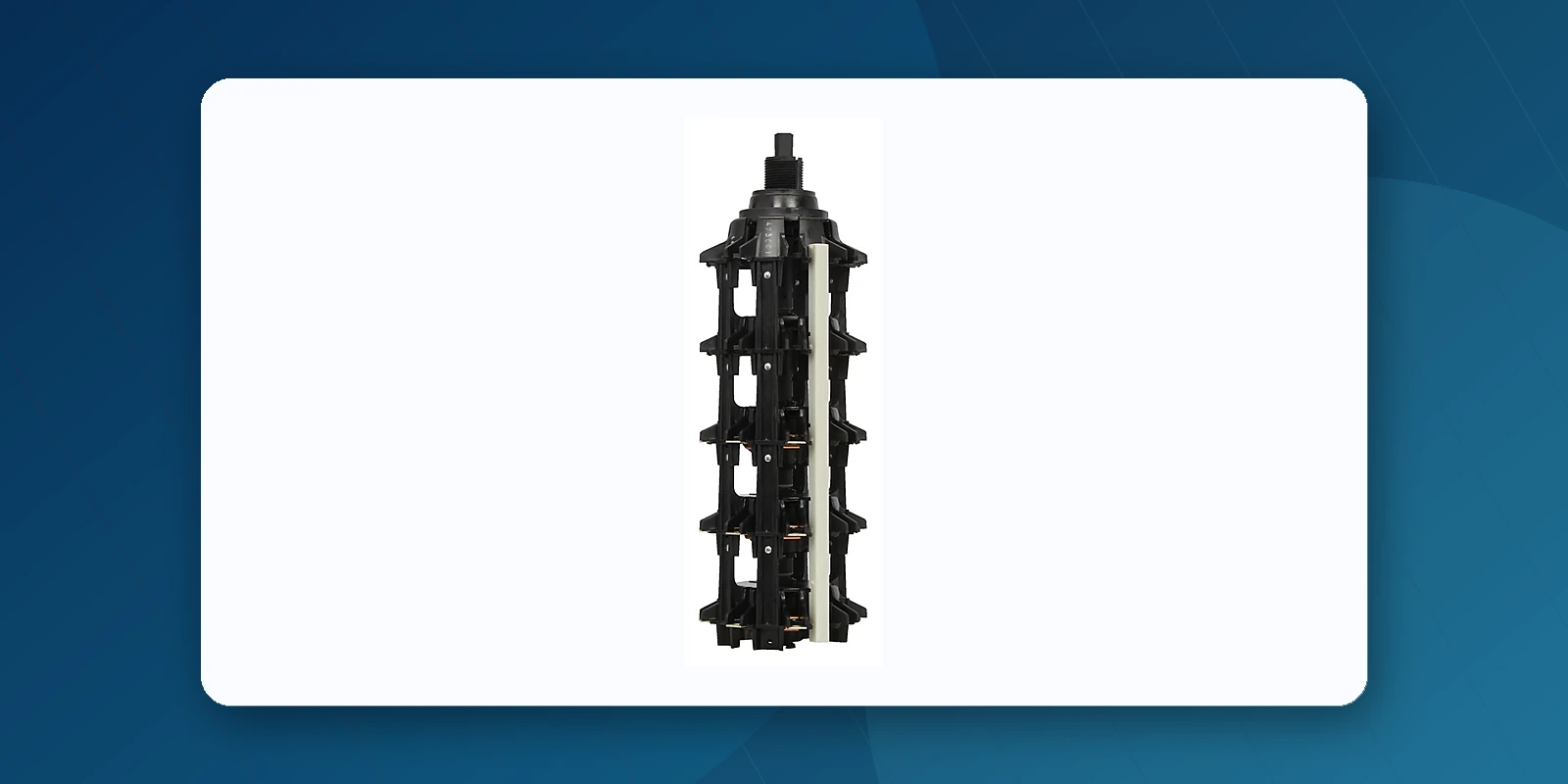
1. Why Voltage Adjustment Matters
Distribution systems rarely operate at exactly the nominal design voltage. Factors including load variation, line voltage drop, capacitor bank switching, and seasonal demand changes can push system voltage several percent above or below nominal. Without voltage adjustment capability, transformers would deliver incorrect secondary voltage — potentially damaging customer equipment on the high side, or causing motor starting problems and reduced efficiency on the low side.
Tap changers solve this problem by providing selectable turns ratios on the transformer's primary winding. By connecting to different tap positions, operators can adjust the effective turns ratio to compensate for system voltage variations, maintaining correct secondary voltage without changing the transformer itself.
2. 100A Externally Operated Tap-Changer Switches — CA800003EN Series
Eaton Cooper's 100A externally operated tap-changer switches provide multi-position voltage adjustment accessible from outside the transformer tank. This series covers one-, two-, and three-phase configurations with various handle options:
- CA800003EN — Master specification for the 100A externally operated tap-changer switch series. Configurable for 1-phase, 2-phase, or 3-phase operation. Features external handle operation for safe, de-energized tap changes without entering the transformer tank.
- Available handle options include: switch cap with wrench operation, lever operation, and hotstick-operable handle
- Padlockable configurations enable lockout/tagout compliance during maintenance
Associated hardware components:
- 2237947A10H — Tap changer switch cap. Standard cap for 100A tap changer switch series. Compatible with wrench, lever, and hotstick operable handles.
- 2237947A301H — Alternative tap changer switch cap configuration with specific mechanical interface.
- 2237471C16M — Switch cap wrench for tap changer operation. Dedicated tool for field service personnel.
- 2237500C36 — Related switch cap component for specific configurations.
3. 150A Tap-Changer Switches — 4038108C14B
For higher-current applications, Eaton Cooper's 150A tap-changer switch series provides increased current handling:
- 4038108C14B — 150A manually or hotstick operable, padlockable tap-changer switch. Key features include:
- Continuous current rating: 150A
- Manual and hotstick operation capability
- Padlockable design for safety compliance
- Tested in accordance with IEEE and Cooper Power Systems standards
- Certified test reports available: CP8918 High Ampere Dual Voltage and Tap Changing Switches Certified Test Report
The 150A switch family includes variants for different voltage classes and phase configurations. The CP8918 certified test report validates full compliance with rated interrupting and withstand capabilities.
4. Dual Voltage Switches
Dual voltage switches enable transformers to operate at two different primary voltage levels — a critical feature for utilities serving areas with multiple distribution voltages, or for OEMs building transformers destined for markets with different standard voltages:
- Dual voltage switch (Eaton Cooper series designation) — Provides series/parallel winding reconnection to select between two voltage levels (e.g., 7200V/12470V, 7620V/13200V, or 14400V/24940V). The switch is typically configured at time of installation and remains fixed for the transformer's service life at that location.
- Certified test report CP8918 covers the dual voltage switch product family, validating switching performance and dielectric integrity.
- Associated model: 2290318D04CH — Dual voltage switch assembly component.
5. Delta-Wye Switches
Delta-Wye switches enable reconfiguration of three-phase transformer winding connections, providing additional flexibility for applications where the transformer may serve either delta or wye-connected loads. This switch is typically installed during transformer manufacturing and configured at commissioning.
6. 3-Position V-Blade Selector Switch
The 3-position V-blade selector switch provides three distinct circuit configurations, commonly used for:
- Voltage selection between three different primary voltage options
- Source selection in dual-feed configurations where only one source is active at a time
- Series/parallel winding reconfiguration for voltage ratio adjustment
This switch complements the 4-position sectionalizing load break switch family but is optimized for voltage selection rather than load current switching.
7. Operating Safety and Best Practices
Tap changers and voltage selection switches should always be operated with the transformer de-energized unless specifically rated for on-load operation. Key safety practices include:
- Verify the transformer is de-energized and properly grounded before operating any tap changer
- Use the Bay-O-Net fuse removal (or load break switch OFF position) to provide visible isolation before tap changes
- Padlock mechanisms in the OFF position during maintenance to prevent accidental re-energization
- Record tap positions in maintenance logs to maintain configuration history
- Verify secondary voltage after tap changes before returning the transformer to service
8. Quality Assurance and Testing
Eaton Cooper tap changers and voltage switches undergo rigorous testing including:
- Contact resistance measurement on all positions
- Dielectric withstand testing between positions and to ground
- Mechanical endurance cycling (thousands of operations)
- Temperature rise testing at rated continuous current
- Fault current withstand and momentary testing
Certified test report CP8918 is available from Jiuyingtech for the 150A high ampere dual voltage and tap changing switch product family.
Manufacturer Resources
Use the latest manufacturer literature for final ratings, ordering codes, installation, and safety requirements.
Frequently Asked Questions
Can an off-circuit tap changer be operated under load?
No. A standard off-circuit tap changer must only be operated after the transformer has been de-energized, isolated, and grounded in accordance with approved procedures.
What is the difference between a tap changer and a dual-voltage switch?
A tap changer adjusts the effective turns ratio in defined steps. A dual-voltage switch reconnects windings, commonly between series and parallel, to support two voltage configurations.
What details are needed to identify a replacement switch?
Provide the catalog number, phase count, current rating, number of positions, contact diagram, shaft and handle arrangement, mounting details, fluid, BIL, and transformer nameplate information.
Need Tap Changers or Voltage Switches?
Jiuyingtech supports inquiries for CA800003EN 100A and 4038108C14B 150A tap changers, dual-voltage switches, and related switch-cap hardware such as 2237947A10H, 2237471C16M, and 2237500C36. Availability is confirmed at quotation.