
Transformer Bushings and Bushing Wells: How to Specify the Interface
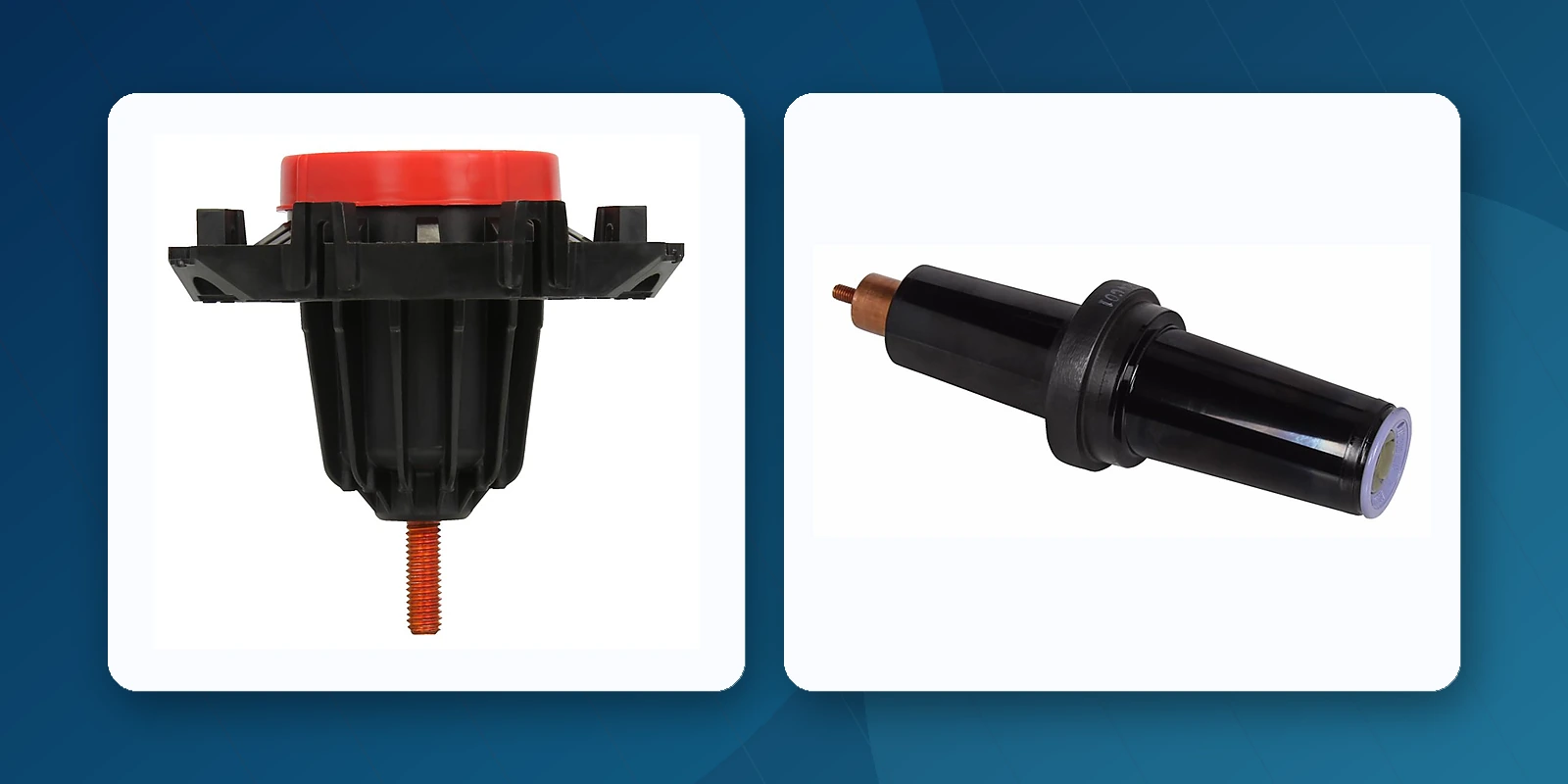
1. Understanding Bushing Types: Loadbreak vs. Deadbreak
Transformer bushings fall into two primary categories based on their operational characteristics:
Loadbreak Bushings (200A Class)
Loadbreak bushings are designed for connections that may be made or broken under load. They feature arc-quenching interfaces that safely extinguish the arc when a loadbreak elbow connector is separated under current. These bushings are rated for 200A continuous current and are the standard choice for radial feed and single transformer connections.
Key Eaton Cooper loadbreak bushing models:
- LB235B150GCX — 35kV, 150/200A internal loadbreak bushing insert. Designed for use in pad-mounted transformer dead-front applications. Features integrated arc-quenching capability for rated loadmake/loadbreak operation when applied and operated according to the manufacturer instructions.
- LE235B150CG — 35kV, 150/200A loadbreak elbow-compatible bushing. Matched interface for 200A loadbreak elbow connectors.
- LE215A00TC / LE215B00TC / LE215C00TC — 15kV, 200A loadbreak elbow insert series. Available in multiple configurations for different cable sizes and connection orientations.
- LE225MA00TC / LE225MC00TC — 25kV, 200A loadbreak elbow insert series. Designed for 25kV class distribution systems with enhanced creepage distance.
Deadbreak Bushings (600A Class)
Deadbreak bushings are designed for connections that are only made or broken when the circuit is de-energized. They are rated for 600A continuous current, making them suitable for main feed connections, loop junctions, and high-capacity transformer primaries. Deadbreak connections use bolted interfaces rather than push-on elbow connections.
Key Eaton Cooper deadbreak bushing models:
- 600A 15 and 25 kV class deadbreak apparatus bushing — Standard 600A interface for medium-voltage applications. Compatible with 600A deadbreak connectors, T-bodies, and junction points.
- 600A 35 kV class deadbreak apparatus bushing — Extended creepage design for 35kV class applications. Incorporates reinforced insulation for higher BIL requirements.
- DB630-40.5T01AY3 — 35kV IEC type C, 630A bushing. IEC-compliant interface for international markets. 630A continuous rating with bolt-in mounting configuration.
- DB250 / BC-D-250 — 250A IEC-compatible bushing series for lighter-duty applications.
- 2638372C01 — Primary bushing for pad-mounted transformers. Standard Eaton Cooper OEM equipment bushing.
- 2085399A01 — Alternative OEM bushing configuration for specific tank designs.
2. Bushing Wells: The BW150R and Beyond
Bushing wells provide the mounting interface between the transformer tank and the removable bushing insert. Eaton Cooper's bushing well product line covers the full voltage spectrum from 15kV to 35kV:
BW150R — 35kV 150/200A Bushing Well
The BW150R is Eaton Cooper's flagship 35kV class bushing well, rated for 150/200A continuous current. This tri-clamp design bushing well features a fixed or removable stud configuration, providing flexibility for different transformer designs. Key specifications include:
- Voltage class: 35kV (max phase-to-phase), 21.9kV (max phase-to-ground)
- Current rating: 150/200A continuous
- BIL rating: 150kV
- Mounting: Tri-clamp design for secure tank wall installation
- Compatible with: 200A, 35kV class loadbreak elbow connectors and bushing inserts
- Production origin, availability, and delivery estimate must be confirmed at quotation
Additional Bushing Well Models
- 2637024C01GCX — Standard OEM bushing well for Eaton Cooper pad-mounted transformer designs. Compatible with multiple insert configurations.
- 4004352B02 — Specialized bushing well for specific voltage and current ratings.
- CA225A — Alternative bushing well configuration with enhanced sealing features.
3. Tap Changer Switch Caps and Related Hardware
Eaton Cooper also supplies the mechanical interface components that complete the bushing system:
- 2237947A10H / 2237947A301H — Tap changer switch caps. Designed for 100A externally operated tap-changer switches. Available in lever or hotstick operable handle configurations with padlockable options.
- 2237471C16M — Switch cap wrench for tap changer operation. Essential tool for field maintenance personnel.
- 2237500C36 — Related switch cap component for specific tap changer configurations.
- 2290318D04CH — Specialized switch cap assembly for multi-position selector switches.
4. High-Voltage Primary Bushings
For higher voltage applications, Eaton Cooper supplies dedicated primary bushings:
- High-voltage primary bushings — Designed for direct connection to overhead lines or substation buswork. Available in multiple voltage classes with appropriate creepage distances for outdoor or indoor installation.
- CA800012EN — 4500A, 1.2kV class external spade / 90-degree internal spade secondary bushings. Heavy-duty design for high-current low-voltage applications.
- CA800003EN — 100A externally operated tap-changer switch series with integrated bushing interface.
5. Selection Criteria: Matching Bushings to Your Transformer Design
Selecting the correct bushing or bushing well involves evaluating:
- System voltage — Match the bushing's maximum phase-to-phase and phase-to-ground ratings to your system parameters. Always allow margin above nominal system voltage.
- Continuous current — Size the bushing to carry the transformer's full-load primary current plus any overload allowance. For 200A class, use loadbreak bushings. For higher currents, move to 600A deadbreak or IEC 630A designs.
- BIL (Basic Impulse Level) — Ensure the bushing's BIL rating meets or exceeds the transformer's specified BIL. This is critical for lightning protection coordination.
- Connection type — Determine whether loadbreak (hotstick-operable elbow) or deadbreak (bolted, de-energized only) connections are required based on operational practices.
- Standard compliance — Verify IEC vs. ANSI/IEEE compliance based on your target market. DB630-40.5T01AY3 serves IEC markets; LB235B150GCX serves ANSI markets.
- Fluid compatibility — Confirm the bushing materials are compatible with your transformer fluid — mineral oil, Envirotemp FR3 natural ester, or R-Temp fluid.
- Mounting configuration — Select tri-clamp (BW150R), bolt-in, or weld-in mounting based on tank design and manufacturing process.
6. Quality and Testing
All Eaton Cooper bushings and bushing wells undergo rigorous production testing:
- Partial discharge testing to verify insulation integrity
- Power frequency withstand voltage testing
- Impulse (BIL) testing on design samples
- Contact resistance measurement on current-carrying interfaces
- Seal integrity testing for oil-immersed applications
- Dimensional verification to ensure connector compatibility
Manufacturer Resources
Use the latest manufacturer literature for final ratings, ordering codes, installation, and safety requirements.
Frequently Asked Questions
What is the difference between a bushing well and a bushing insert?
The well is the apparatus-mounted interface. A compatible insert is installed in the well to create the mating interface for a loadbreak elbow or related accessory.
Can a 200 A loadbreak component mate with a 600 A deadbreak component?
Not directly. The current class and interface geometry must match, unless a specifically designed reducing tap plug, adapter, or connector system is used.
Is voltage class enough to confirm interchangeability?
No. Verify the applicable interface standard, dimensions, current class, BIL, stud configuration, and the exact mating component. Similar voltage labels do not guarantee compatibility.
Need Bushings or Bushing Wells?
Jiuyingtech supports inquiries for BW150R, LB235B150GCX, DB630-40.5T01AY3, and related Eaton Cooper bushing accessories. Exact interface matching, availability, and documentation are confirmed at quotation.